ITSC 2026  ·  Automated Vehicles at the Limits: Lessons and Opportunities from the Racetrack

Trajectory Planning and Control at the Limits: an Open Experimental Benchmark on the RoboRacer Platform

Mattia Piccinini1, Patrick Zambiasi2, Aniello Mungiello3, Mattia Piazza4, Felix Jahncke1, Johannnes Betz1
Accepted

Paper (Coming Soon) Code
Framework Architecture
Figure 1. (a) Overview of our trajectory planning and control framework, and (b) real-world results obtained by deploying the framework on our RoboRacer.

Abstract

We present a modular framework to benchmark new and existing methods for trajectory planning and control in high-acceleration maneuvers that push autonomous driving to the limits. Our framework includes time-optimal raceline generation, online time-optimal velocity replanning, geometric path tracking controllers, and a new model-structured neural network (MS-NN) to learn the inverse dynamics for steering control. We deploy our framework on a 1:10-scale RoboRacer platform, using two circuits. Through several ablations with cautious and aggressive racelines, we study the performance of single modules and their combinations. We show that our MS-NN significantly improves tracking accuracy, decreases steering oscillations, and is physically interpretable. Moreover, online velocity replanning improves lap times by compensating for execution errors, and enables the vehicle to safely reach higher speeds and accelerations. To support future research, our code, datasets, videos and results are publicly available on our website.

Key Contributions

1

Closed-Loop Framework

We benchmark new and existing methods for time-optimal planning and control near the handling limits, including geometric controllers, MS-NN steering controllers, and an online velocity planner. These methods have never been used in a unified closed-loop stack for real-world autonomous racing.

2

New Model Structured Neural Network

We present a new MS-NN that learns the nonlinear coupled longitudinal-lateral dynamics for steering control at high accelerations, while preserving interpretability.

3

Ablation Study

Through several ablations, we analyze the performance of single modules and their combinations, quantifying the impact of the MS-NN and online velocity replanning on trajectory planning, tracking, and lap-time.

4

Comprehensive Experimental Tests

We conduct our experiments on a 1:10-scale autonomous racing platform, and we publicly release all software modules, datasets, and results.

Methods

1

Time-optimal raceline

Generate offline the time-optimal raceline based on a point-mass model with user-defined acceleration and velocity constraints.

Code
2

Path Tracking Controllers

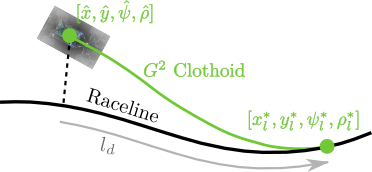
The path-tracking controller computes future path curvature references. We compare two path tracking controllers, the Pure Pursuit (PP) and the Clothoid-based (CL)
Framework Architecture
Figure 2. Clothoid-based (CL) path tracking controller: we connect the current vehicle pose and curvature to a look-ahead (ld) raceline point using a G2 clothoid, which enforces continuity of position, heading, and curvature.
CL Code
3

Online Time-Optimal Velocity Replanning

The velocity replanning module, which computes time-optimal velocity and longitudinal-lateral acceleration profiles over a planning horizon via a forward-backward optimizer (FBGA) accounting for the vehicle's nonlinear constraints on accelerations and velocity.

FBGA Code
4

Steering Control: Model-Structured Neural Network

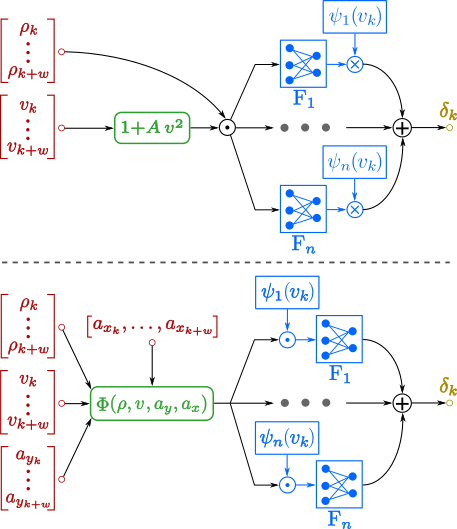
The velocity profile is tracked by the motor controller, while steering commands are generated by a new MS-NN using curvature, velocity, and acceleration references. The estimated vehicle state closes the loop.
Framework Architecture
Figure 2. Baseline MS-NN steering controller (top), and our extended version (bottom).
MS-NN Code

Quantitative Results and Benchmarking

Framework Architecture
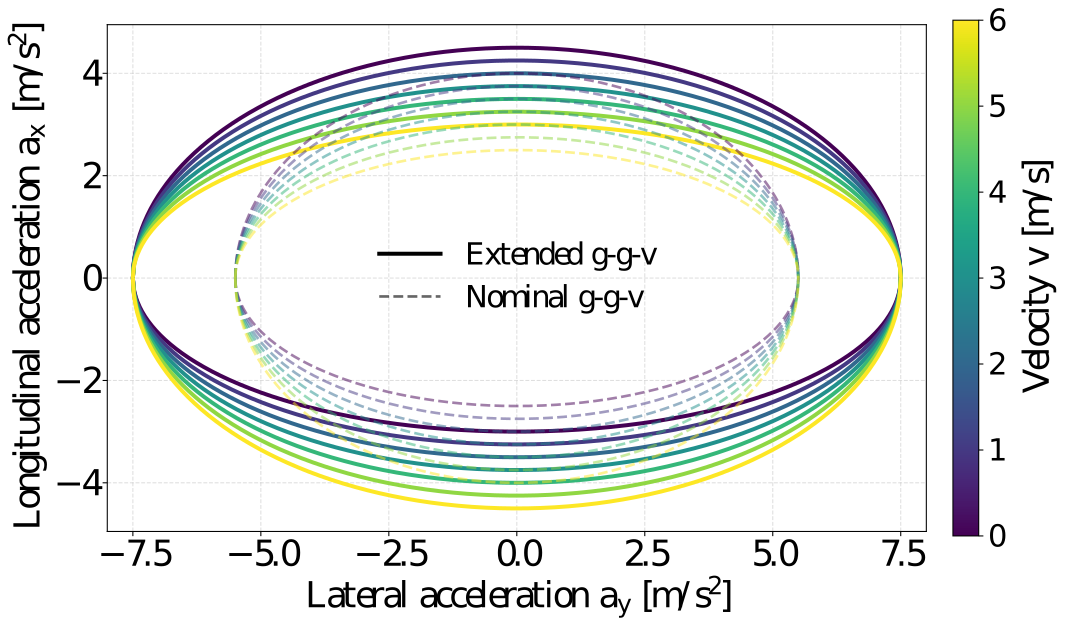
Figure 4. Velocity-dependent acceleration limits (g-g-v diagrams) used as constraints for offline raceline generation and online velocity replanning.

Comparing the baseline and proposed MS-NN variants.

↑ = higher is better, ↓ = lower is better.

Dataset MS-NN RMSE↓ [m] FVU↓ [-]
Framework Architecture
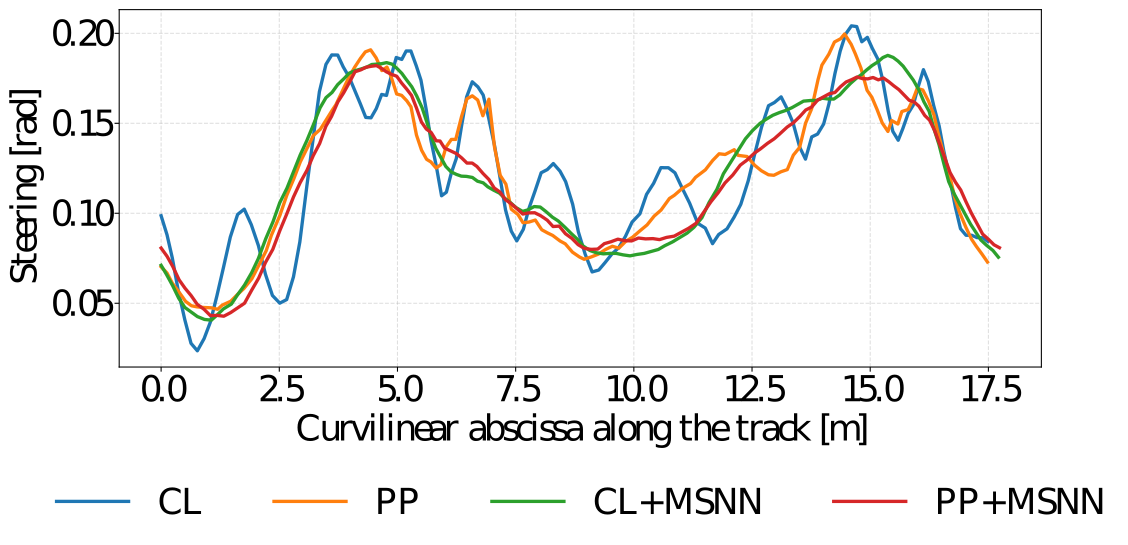
Figure 5. Steering angles generated by the four controller combinations on track A, with the cautious raceline and without velocity replanning. Coupling our MS-NN with PP / CL significantly reduces steering oscillations

Trajectory tracking on track A with the cautious raceline and without velocity replanning. Our MS-NN improves path tracking, lap times, and steering smoothness.

Controller Path Tracking [cm] Lap Time [s] ↓ RMS Steering Rate [rad/s] ↓
MeanMax

Track A: CL-based path tracking (without MS-NN steering controller and without FBGA velocity planning), with the cautious g-g-v, used to train the MS-NN steering controller.

Impact of online velocity replanning with FBGA on the closed-loop performance on track B. FBGA enables the use of the extended g-g-v constraints, leading to improved lap times. Best results are highlighted, second best are underlined.

Lateral Controller Online Velocity Replanning g-g-v Type Max v [m/s] Max ax [m/s2] Max ay [m/s2] Lap Time [s]
Framework Architecture
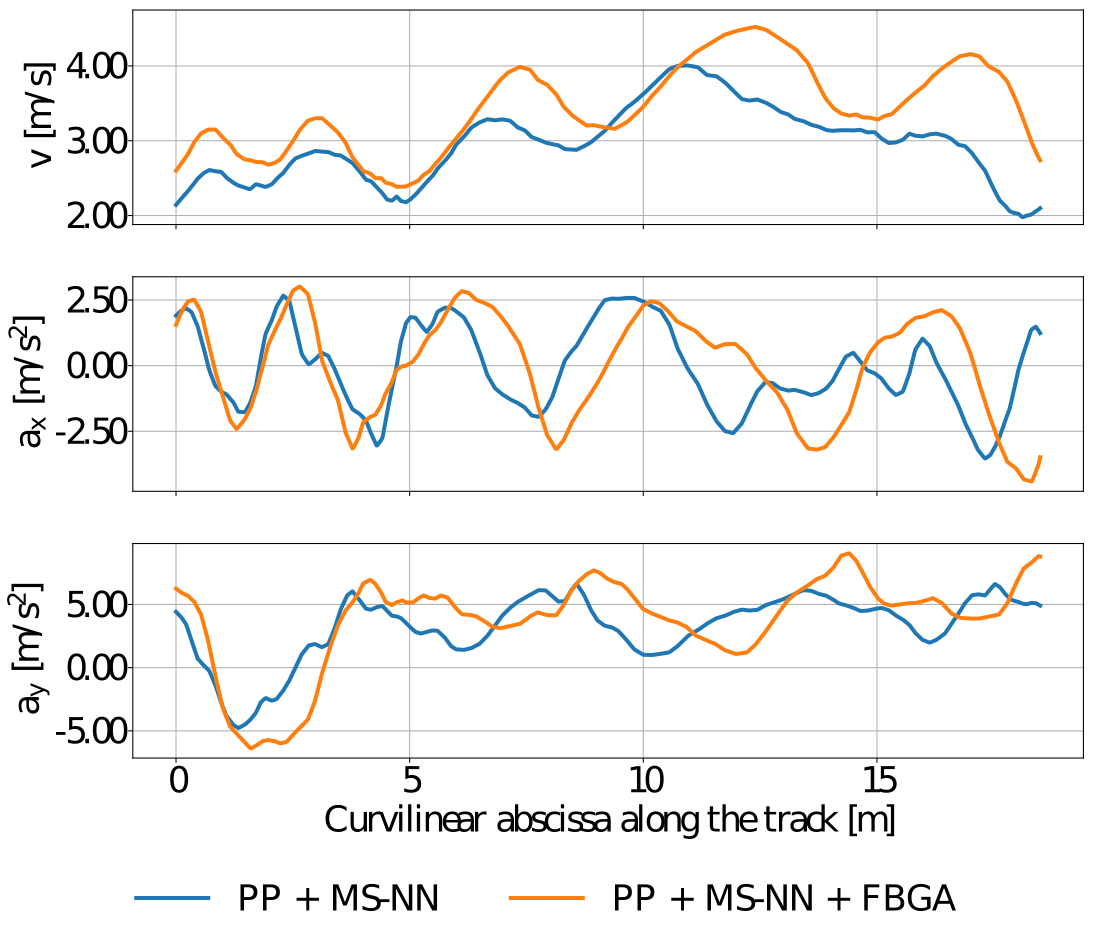
Figure 6.Velocity v, longitudinal and lateral accelerations ax, ay for PP + MS-NN (nominal g-g-v) and PP + MS-NN + FBGA (extended g-g-v). With online velocity replanning (FBGA), the extended g-g-v enables the vehicle to reach higher accelerations and speeds, yielding faster lap times
Framework Architecture
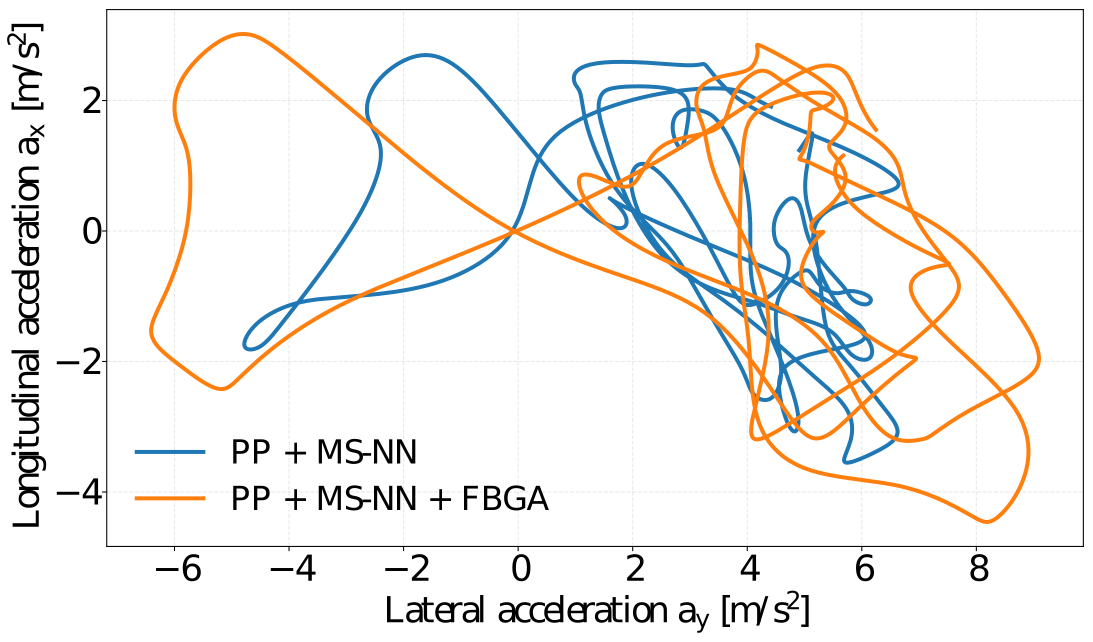
Figure 7. Executed longitudinal and lateral accelerations. PP + MS-NN follows a slower raceline under nominal \GGV{} constraints, while PP + MS-NN + FBGA reaches higher accelerations enabled by the extended g-g-v constraints and online velocity replanning
Framework Architecture
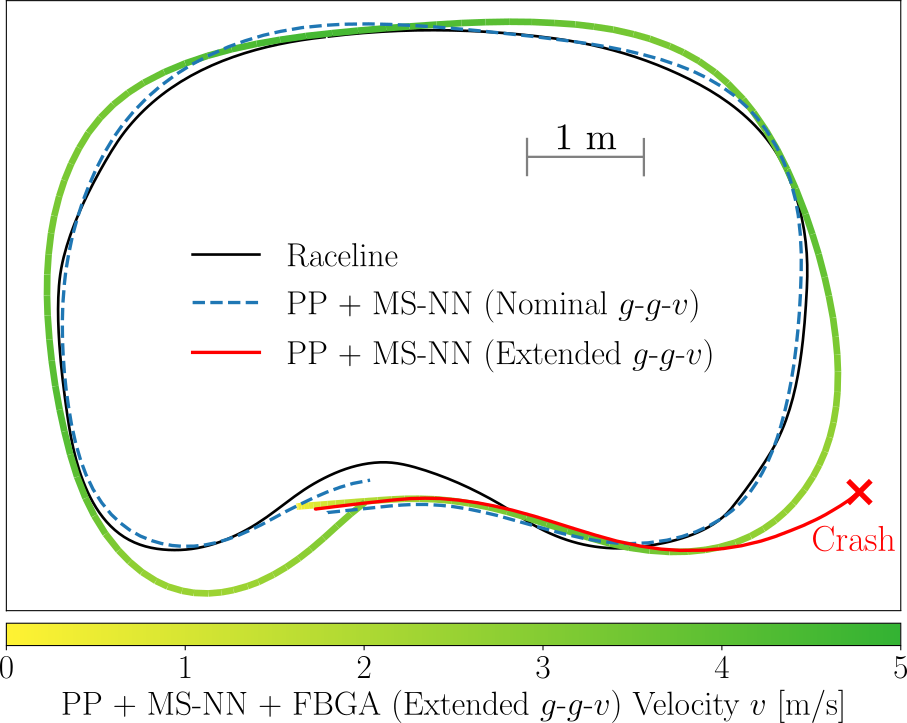
Figure 8. Trajectory of the best configuration (PP + MS-NN + FBGA) under the extended g-g-v constraints, with the colorbar showing the velocity profile. PP + MS-NN under nominal g-g-v (dashed) stays closer to the offline raceline but loses 8.3% in lap time. Using the extended g-g-v without FBGA leads to track boundary crashes (red).

Track B: PP + MS-NN + FBGA with extended g-g-v (best performance)

Quantitative Results

The overall best performance is achieved by the PP + MS-NN + FBGA configuration under the extended g-g-v envelope, reaching:

8.3%
Lap Time Reduction
9.05 m/s2
Maximum Lateral Acceleration
3.018 m/s2
Maximum Longitudinal Acceleration
4.522 m/s
Maximum Speed
-->

BibTeX

@INPROCEEDINGS{RoboRacer2026,   
author={Piccinini, Mattia and Zambiasi, Patrick and Mungiello, Aniello and Piazza, Mattia and Jahncke, Felix and Betz, Johannes},
booktitle={2026 IEEE 29th International Conference on Intelligent Transportation Systems (ITSC)},   
title={Trajectory Planning and Control near the Limits: an Open Experimental Benchmark on the RoboRacer Platform},   
year={2026},   
notes={accepted}} }